Old Ranger Days
USA Outdoor Weekly
USA Outdoor Weekly: Wildfires, Flash Floods and Extreme Heat (Aug. 16–22, 2026)
In this guide
- The 60-Second Trip Decision
- 1. National Wildfire Activity Reached Preparedness Level 5
- 2. Oregon and Washington Fire Closures Affect Recreation Access
- 3. Capitol Reef Flash Flooding Closed Roads and Trails
- 4. NOAA Flags a Late-August Extreme-Heat Threat
- 5. Proposed National Roadless Rule Change Entered Public Comment
- 6. New Mexico Campgrounds Scheduled a Short Upgrade Closure
- Gear Recall Watch
- Five Practical Amazon US Products for This Week’s Conditions
- What to Check Before Leaving Home This Week
- Competitor Coverage and the Missing Angle
- Sources and Editorial Note
USA Outdoor Weekly for August 16–22, 2026: National wildfire activity reached the highest preparedness level, new fire closures affected Pacific Northwest recreation, flash flooding closed roads and trails at Capitol Reef, and federal forecasters flagged a late-August extreme-heat threat across a broad southern tier. A major National Forest policy proposal also entered public comment. Here is the practical, source-checked briefing for U.S. hikers, campers and public-land travelers.
Conditions and product information were checked August 23, 2026. Closures, weather and fire restrictions can change within hours. Always confirm the managing agency’s current alert page immediately before departure.
The 60-Second Trip Decision
Pacific Northwest trip: check the exact National Forest or National Park closure map before driving. The national fire system was at Preparedness Level 5 on August 22, and several Oregon and Washington incidents included road, trail and recreation-site closures.
Utah canyon or desert trip: treat a flash-flood warning as a route-changing event, not a reason to wait at the trailhead. Capitol Reef closed Scenic Drive and Grand Wash during a warning on August 22.
Southern-tier trip after August 29: recheck the National Weather Service forecast and HeatRisk. NOAA’s August 22 outlook identified a broad extreme-heat threat for August 30 into early September.
Any remote trip: carry a second communication plan, extra water capacity and enough daylight margin to reroute. A GPS track or gear purchase does not override an evacuation order, closure or unsafe weather.
1. National Wildfire Activity Reached Preparedness Level 5
The National Interagency Coordination Center listed the United States at Preparedness Level 5 on August 22—the highest national level. The National Interagency Fire Center reported 113 new fires on August 21, including 11 new large fires. Firefighters were working 78 large incidents with 22,751 personnel assigned nationwide. The Northwest had the greatest concentration of large-fire activity.
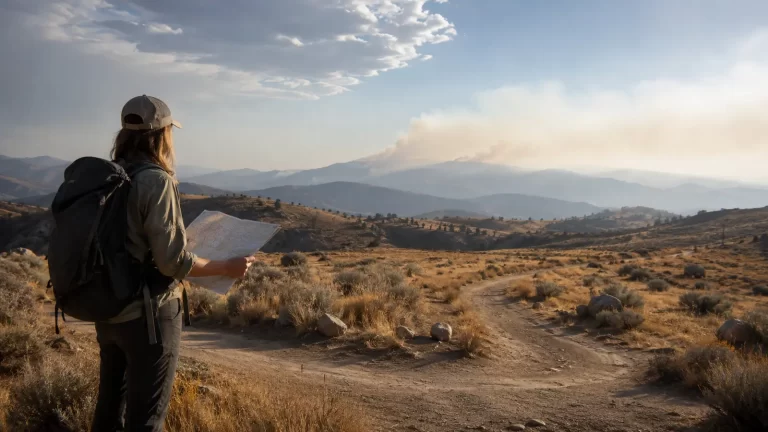
For travelers, the number that matters most is not acreage; it is whether the route, access road, campground or evacuation corridor intersects an active incident. Read the incident and land-manager pages before leaving cell service, save an offline map and identify a second destination outside the affected area.
Official source: National Interagency Fire Center — National Fire News, August 22, 2026.
2. Oregon and Washington Fire Closures Affect Recreation Access
Mt. Hood National Forest updated a closure around the Austin and Mitchell fires on August 20. The Forest Service said the order protects visitors, firefighters and natural resources. Other incidents in the August 22 national situation report included the Three Queens, Grand Park 2, King, Grasshopper, Austin, The Narrows and High Lava fires, with various area, road and trail closures reported.
Mount Baker–Snoqualmie National Forest also listed closures associated with the Three Queens and Grand Park 2 incidents. A closure boundary can extend beyond the visible smoke or flame front because crews need roads, trailheads and airspace for operations. Do not enter a closed area to “see how conditions look.”
Before a Northwest trip: check Mt. Hood National Forest alerts, Mount Baker–Snoqualmie National Forest alerts and the daily national incident report. If smoke is the concern rather than direct fire, use our wildfire smoke and hiking guide to interpret AQI and exposure.
3. Capitol Reef Flash Flooding Closed Roads and Trails
Capitol Reef National Park’s August 22 conditions update listed Scenic Drive as closed because of a flash-flood warning, with Grand Wash and Capitol Gorge also closed. Hartnet Road was reported partially washed out near the campground and not recommended, while conditions on several remote roads remained unknown.
The lesson extends across the Colorado Plateau: dry ground at your vehicle does not prove a slot canyon or wash is safe. Rain falling miles upstream can reach a narrow drainage later. Check both the park alert and the National Weather Service forecast, avoid entering a wash when storms threaten its watershed, and never drive through flowing water.
Official source: Capitol Reef National Park alerts and road conditions, updated August 22, 2026. For a deeper decision framework, see our Southwest monsoon hiking safety guide.
4. NOAA Flags a Late-August Extreme-Heat Threat
NOAA’s Climate Prediction Center update issued August 22 identified a high risk of extreme heat for much of the Desert Southwest, Southern Rockies, Southern and Central Plains and Lower Mississippi Valley for August 30–31. A broader slight-risk area extended into early September, and portions of the Plains and Mississippi Valley were also flagged for rapid-onset drought risk.
Long-range risk maps are planning signals, not local trail forecasts. As the trip approaches, check the point forecast, hourly temperature, overnight low and HeatRisk for the exact trailhead. On exposed routes, start early only when the return can also be completed before dangerous heat; carry route-appropriate water and electrolytes; and turn around at the first sign that pace, cooling or water consumption is departing from the plan.
Official sources: NOAA Climate Prediction Center hazards outlook and NOAA 8–14 day outlook, updated August 22, 2026. Build a practical kit with our hot-weather day-hiking gear guide.
5. Proposed National Roadless Rule Change Entered Public Comment
A Forest Service proposed rule published in the Federal Register on August 20 would rescind the national 2001 Roadless Area Conservation Rule. The proposal says the separate Idaho and Colorado roadless rules would remain in effect. The public comment deadline is September 21, 2026, under docket FS-2025-0001.
This is a proposed rule, not a same-day trail-access change. Recreationists should avoid treating it as either an immediate opening or closure. Its significance is longer-term: inventoried roadless areas can shape remote recreation, habitat, road construction and forest-management decisions. Readers who want to participate should review the actual proposal and submit specific, evidence-based comments through the official docket.
Official sources: Federal Register proposed rule, August 20, 2026 and Regulations.gov docket and comment instructions.
6. New Mexico Campgrounds Scheduled a Short Upgrade Closure
Gila National Forest announced that Bighorn and Cosmic campgrounds along U.S. 180 north of Glenwood would close beginning August 24 while crews install shade ramadas. The Forest Service expected reopening on August 29, construction permitting. Travelers should confirm the reopening before relying on either campground and have an alternate legal campsite.
Official source: Gila National Forest announcement, released August 20, 2026.
Gear Recall Watch
Old Ranger Days reviewed the CPSC recall database for this reporting window but did not include a recall because no hiking or camping item met our verification threshold for an August 16–22 announcement. That is not a guarantee that every item in your gear closet is clear. Search the U.S. Consumer Product Safety Commission recall database by brand and model—especially before using secondhand stoves, batteries, generators, climbing equipment or children’s outdoor products.
Five Practical Amazon US Products for This Week’s Conditions
As an Amazon Associate, Old Ranger Days earns from qualifying purchases.
These are current, established U.S.-market products selected for their relevance to heat, fire closures, storms and remote-trip planning. We did not use prices, ratings, sales volume or personal-testing claims. Links are standard Amazon.com pages without an affiliate tag so the site owner can replace them later.
1. Sawyer Squeeze Water Filter System SP129
Best use: treating backcountry freshwater when a park water system is unavailable or a planned source becomes unreliable. Ideal buyer: backpackers and emergency-kit builders who will learn correct squeezing, cleaning and backflushing. Sawyer specifies a 0.1-micron absolute hollow-fiber filter and reduction of bacteria and protozoa to the stated laboratory-tested levels. Key limitation: it is a filter, not a universal purifier; it does not make seawater drinkable and should not be assumed to remove viruses, dissolved chemicals or every toxin. Hollow-fiber filters must also be protected from freezing after use.
View the Sawyer Squeeze SP129 on Amazon US | Manufacturer specifications
2. Garmin inReach Mini 2 Satellite Communicator
Best use: two-way messaging, tracking and interactive SOS beyond reliable cell coverage. Ideal buyer: remote hikers who will activate, test and understand the service before departure. Garmin lists a built-in 1,250 mAh rechargeable battery and an IPX7 water rating. Key limitation: messaging, tracking, weather and SOS features require an active satellite subscription and a sufficiently clear view of the sky. It is not a substitute for route judgment or an evacuation plan.
View the Garmin inReach Mini 2 on Amazon US | Manufacturer specifications
3. Black Diamond Spot 400 Headlamp
Best use: pre-dawn starts, unexpected delays and campsite tasks. Ideal buyer: hikers who want a 400-lumen maximum setting, red light, lock mode and a choice between three AAA batteries or Black Diamond’s optional BD 1500 rechargeable battery. Black Diamond rates the housing IPX8. Key limitation: the rechargeable battery is sold separately, and a headlamp provides visibility—not navigation, communication or rescue. Learn the two-button controls before relying on it in the dark.
View the Black Diamond Spot 400 on Amazon US | Manufacturer specifications
4. Midland ER310 Emergency Crank Weather Radio
Best use: car camping, basecamp and household emergency kits where NOAA weather alerts and redundant power options are useful. Ideal buyer: campers who want AM/FM/weather bands, a flashlight and USB, solar, hand-crank and replaceable-battery options in one unit. Midland’s support documentation lists a rechargeable lithium-ion battery plus six-AA backup capability. Key limitation: reception depends on location and terrain, while hand cranking is a backup—not an efficient primary charging plan. Confirm the specifications in the manual supplied with the current production unit.
View the Midland ER310 on Amazon US | Manufacturer user guide
5. 3M Aura 9205+ N95 Particulate Respirator
Best use: a compact contingency item for non-oil airborne particles, including smoke particles encountered while leaving an affected area. Ideal buyer: adults who can achieve a proper seal and understand that the safest response to unhealthy wildfire smoke is exposure reduction or relocation. The 9205+ is NIOSH-approved as an N95 for at least 95% filtration efficiency against certain non-oil particles. Key limitation: an N95 does not supply oxygen and does not protect against gases or vapors. Facial hair, poor fit and damage can prevent an adequate seal; it does not make hiking in hazardous smoke safe.
View the 3M Aura 9205+ on Amazon US | Manufacturer respiratory-protection information
What to Check Before Leaving Home This Week
Land manager: open the exact NPS, USFS, BLM or state-park alert page—not only a map app. Save closure maps and permit details offline.
Weather: review the point forecast, radar, HeatRisk, air quality and upstream rain potential. Recheck shortly before departure.
Fire: use the NIFC incident report and the managing unit’s closure order. Avoid closed roads and do not rely on a social-media photo to judge smoke or access.
Water: verify every developed water source and carry enough capacity for a failure. Treatment equipment does not create water where the source is dry.
Communication: leave an itinerary and turnaround time with a reliable person. Test satellite devices outdoors with an active subscription.
Light: bring a headlamp even on a day hike. Late-summer daylight is shortening, and detours around closures can add time. Review our complete hiking headlamp buying guide.
Competitor Coverage and the Missing Angle
Large U.S. outdoor publishers continue to emphasize individual wildfire stories, destination roundups, new-gear announcements and product-test rankings. Those formats are useful for discovery, but they often separate the news from the traveler’s decision. Old Ranger Days’ opportunity is a weekly, official-source briefing that connects each development to a specific action: reroute, verify water, check a closure boundary, change start time, submit a public comment or carry a tested backup.
Future standalone opportunities from this week include a Pacific Northwest wildfire-closure planning workflow, an explainer on how the Roadless Rule proposal could affect recreation planning without overstating immediate impacts, and a weather-radio comparison focused on car camping rather than generic emergency rankings.
Sources and Editorial Note
Primary reporting sources: National Interagency Fire Center and NICC; NOAA Climate Prediction Center; National Park Service; U.S. Forest Service; Federal Register; Regulations.gov; U.S. Consumer Product Safety Commission; and current manufacturer documentation. Competitor publications were used only to identify coverage patterns and missing reader questions. Old Ranger Days did not copy their wording, rankings, testing claims, images or conclusions.
Old Ranger Days is research-based: we work from verified specifications and official sources, and never claim hands-on testing unless it happened. Some links may be affiliate links. Editorial policy · Affiliate disclosure