 Old Ranger Days
Packs & Camp Gear
Hiking Headlamp Buying Guide: Lumens, Batteries and 4 Amazon Options
In this guide
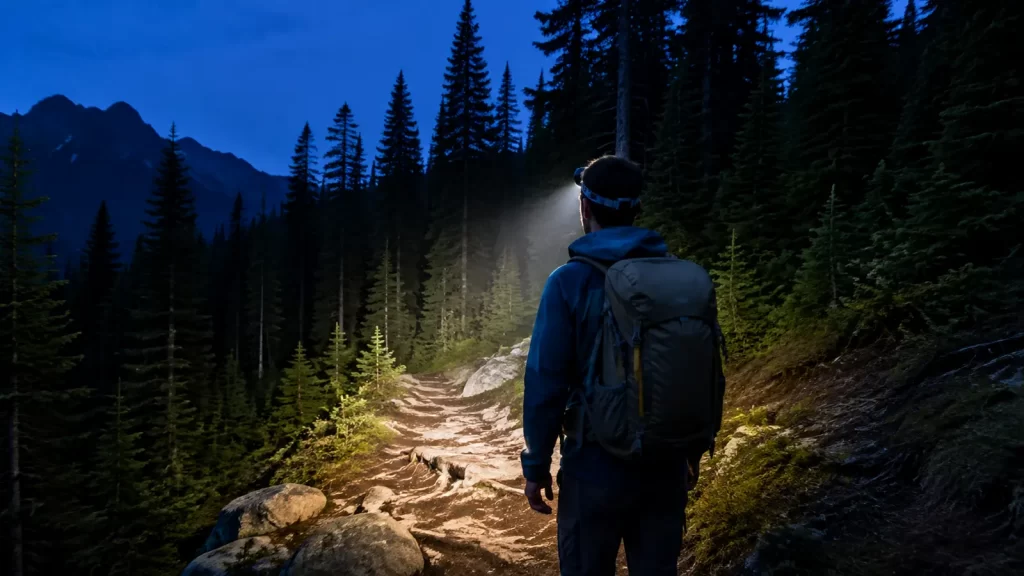
Quick answer: For most U.S. day hikers, a headlamp with a usable low mode, a comfortable wide beam, red light, a lock function, and a dependable power plan matters more than the biggest lumen number. Choose a brighter mixed beam for fast movement or route-finding, a lighter wide-beam lamp for camp and emergency backup, and always carry spare power.
The National Park Service includes illumination among the Ten Essentials and recommends a headlamp because it keeps both hands free. That matters when a “short” afternoon hike becomes a careful walk back after sunset, when you need both hands for trekking poles, or when you are checking a map in rain.
How to choose a hiking headlamp
Start with the trip, not the specification sheet. A lamp for changing clothes in a campground does not need the same beam as a pre-dawn summit approach. These practical ranges are planning guidelines, not universal safety guarantees:
| Use case | What to prioritize | Practical output range | Key limitation to check |
|---|---|---|---|
| Camp chores and emergency backup | Wide beam, low mode, simple controls | About 100–300 lumens | Can you prevent accidental activation? |
| Day hike that may finish after dark | Comfort, red light, spare power | About 250–450 lumens | Does useful runtime match your return plan? |
| Regular night hiking or backpacking | Mixed beam, weather resistance, stable fit | About 350–650 lumens | Does brightness step down as the battery drains? |
| Trail running or technical route-finding | Beam distance, balance, secure headband | 500+ lumens may be useful | Heat, weight, and short high-output runtime |
1. Lumens are only the starting point
Lumens measure total light output, not how well a lamp places that light on a rocky trail. A very bright narrow spot can be uncomfortable for camp tasks, while a broad flood beam may not show a distant junction. Also, maximum output is commonly a temporary setting. Compare the manufacturer’s full runtime chart and test the modes before a consequential trip.
2. Match the beam to your pace
A wide beam is comfortable for cooking, reading signs, and walking slowly. A mixed beam combines nearby context with longer reach and is usually better for hiking at speed. Avoid staring only at the brightest central spot; you need enough peripheral information to see roots, drainage dips, and the edge of the tread.
3. Choose a power system you can support
- Integrated rechargeable battery: convenient for frequent use, but you cannot instantly swap in common batteries.
- AAA batteries: easy to replace, useful for emergency kits and long trips, but create recurring cost and waste.
- Hybrid system: can accept a proprietary rechargeable pack or standard batteries, offering flexibility at the cost of another component to manage.
Cold conditions can reduce battery performance. Keep a backup power source protected and reasonably warm, and never assume the battery indicator tells you exactly how many trail hours remain.
4. Look for red light and a lock mode
Red light is useful around camp because it is less disruptive to other people and can help preserve dark adaptation. Mount Rainier National Park specifically advises using white light only when necessary on night hikes. A lock function is equally practical: it helps prevent the lamp from turning on inside your pack and arriving at the trailhead partially discharged.
5. Read the water-resistance claim correctly
“Weather resistant” and “waterproof” are not interchangeable. Read the exact IP rating and the manufacturer’s conditions. A lamp designed for rain may not be intended for submersion. Inspect the charging-port cover and battery compartment after every wet trip.
Four Amazon US headlamp options by use case
As an Amazon Associate, Old Ranger Days earns from qualifying purchases.
These are use-case matches based on current manufacturer specifications, not personal test results or a universal ranking. Prices and availability can change.
| Model | Best use | Power | Main limitation |
|---|---|---|---|
| Petzl TIKKA 350 | Camp and day-hike backup | 3 AAA; CORE compatible | Wide beam is not designed for maximum distance |
| Black Diamond Spot 400 | Versatile day hiking | 3 AAA; optional dual-fuel battery | Rechargeable battery is not included in this listing |
| Nitecore NU25 MCT UL | Ultralight backpacking | Integrated USB-C rechargeable | No instant AAA swap |
| Petzl ACTIK CORE 625 | Night hiking and faster movement | CORE rechargeable; 3 AAA compatible | More output than many casual users need |
Petzl TIKKA 350: simple camp and backup choice
Best use: camp chores, easy walking, and a Ten Essentials backup. Ideal buyer: a beginner who wants simple controls and standard batteries. Petzl lists 350 lumens, a wide beam, red lighting, a 94 g weight, IPX4 weather resistance, and compatibility with three AAA batteries or the optional CORE rechargeable battery.
Limitation: the wide beam favors nearby comfort rather than long-distance route spotting. Check the Petzl TIKKA on Amazon US.
Black Diamond Spot 400: flexible day-hiking setup
Best use: a day-hiking kit that may occasionally be used after sunset. Ideal buyer: someone who values red night vision, dimming, brightness memory, a battery meter, and a lock function. Black Diamond specifies a 400-lumen maximum and dual-fuel compatibility.
Limitation: this Amazon listing is the AAA-powered Spot 400, not the integrated rechargeable Spot 400-R. The optional rechargeable battery is a separate purchase. Check the Black Diamond Spot 400 on Amazon US.
Nitecore NU25 MCT UL: ultralight backpacking option
Best use: weight-conscious backpacking, running, and camp use. Ideal buyer: a hiker who wants a compact USB-C rechargeable lamp and selectable warm, neutral, or cool white light. Nitecore lists a 400-lumen maximum, a 144-yard maximum throw, red light, and a total weight around 1.65 oz for the UL configuration.
Limitation: an integrated rechargeable battery cannot be replaced instantly with AAA cells. Carry a compatible charging plan for longer trips. Check the Nitecore NU25 MCT UL on Amazon US.
Petzl ACTIK CORE 625: stronger mixed beam for movement
Best use: planned night hiking, pre-dawn starts, and faster trail movement. Ideal buyer: a regular user who wants a rechargeable battery plus AAA compatibility. Petzl lists 625 lumens, wide and mixed beams, red lighting, a lock function, a battery-level indicator, and its HYBRID CONCEPT power system.
Limitation: it costs and weighs more than a simple emergency lamp, and maximum output should not be confused with all-night constant output. Check the Petzl ACTIK CORE on Amazon US.
A safer headlamp routine for U.S. trails
- Charge the lamp or install fresh batteries the night before.
- Unlock it and cycle through every mode before leaving home.
- Pack spare power in a protected container.
- Start using the lamp before the trail becomes difficult to read.
- Use a moderate setting whenever possible; save maximum output for route checks.
- Do not point the beam into another person’s eyes.
- After rain, dry the lamp and inspect seals and charging covers.
A headlamp does not make night hiking automatically safe. Poor visibility can hide drop-offs, wildlife, unstable footing, and navigation errors. Check official park or forest alerts, tell someone your route and return time, and turn around before the plan depends on equipment you have not practiced with.
Build the rest of your system with our day-hiking gear list, satellite safety device guide, and Southwest monsoon hiking safety rules.
Frequently asked questions
How many lumens do I need for hiking?
For many hikers, roughly 250–450 lumens is a useful general-purpose range, but beam shape, low-mode usability, runtime, terrain, speed, and weather matter just as much. Faster movement and distant route-finding may justify more output.
Is a phone flashlight enough for a day hike?
No. Great Smoky Mountains National Park explicitly says a phone does not count as illumination in its Ten Essentials guidance. A phone also ties navigation and communication to the same battery used for light.
Should I carry two headlamps?
For remote travel, technical objectives, or trips that intentionally continue after dark, a small independent backup lamp can reduce a single point of failure. At minimum, carry spare power compatible with your primary lamp.
Does red light protect night vision?
Red light can be less disruptive to dark adaptation and to nearby campers. It is not a substitute for sufficient white light when you need to identify hazards or confirm the trail.
Official and manufacturer sources
- National Park Service: Ten Essentials
- Great Smoky Mountains National Park: Hiking Safety
- Mount Rainier National Park: Full Moon Hikes
- Petzl TIKKA specifications
- Petzl ACTIK CORE specifications
- Black Diamond Spot 400 specifications
- Nitecore NU25 MCT UL specifications
Specifications and Amazon listings were checked on August 18, 2026. Verify the exact model, included battery, and manufacturer documentation before buying.
Old Ranger Days is research-based: we work from verified specifications and official sources, and never claim hands-on testing unless it happened. Some links may be affiliate links. Editorial policy · Affiliate disclosure