Old Ranger Days
Trail Safety
Hiking During Hunting Season: Blaze Orange, Dogs and Trail Rules
In this guide
- Why This Matters Before Peak Fall Foliage
- A Five-Minute Pre-Hike Hunting Check
- What Color Should Hikers Wear?
- Trail Behavior When Hunters May Be Nearby
- Hiking With a Dog During Hunting Season
- Three Amazon US Visibility Options
- When to Choose a Different Trail
- Frequently Asked Questions
- Official Sources and Editorial Limits
Quick answer: You can usually keep hiking during hunting season, but first confirm that your trail and surrounding land are open to hunting. Wear solid fluorescent blaze orange that can be seen from multiple directions, keep dogs leashed and highly visible, stay on established trails, avoid low-light hours when practical, and follow posted closures. Rules and season dates change by state, game species, weapon type, and individual property, so check the managing agency before every trip.
Hiking during hunting season is a normal part of fall recreation across much of the United States. National Forests, state forests, wildlife management areas, and some National Park Service units may allow hunting while remaining open to hikers. Other national parks prohibit it, and individual state parks may have designated hunting zones. The land designation on a map is only a starting point—not the final answer.
This guide is for non-hunting hikers, trail runners, families, and dog owners who share public land in fall. It is not a substitute for current hunting regulations or property-specific instructions.
Why This Matters Before Peak Fall Foliage
Hunting activity can begin before many hikers think of “deer season.” New York’s published 2026 schedule, for example, includes early bear opportunities beginning September 12 in part of the Southern Zone and September 19 in portions of the Northern Zone, while dates differ elsewhere in the state. Cumberland Island National Seashore has a managed archery hunt scheduled for September 22–24, 2026. These examples are not a national calendar; they show why checking only one familiar deer-firearm weekend is insufficient.
Land access also varies widely. Pennsylvania reports that all 20 state forests and most state parks are open to hunting during established seasons. By contrast, Rocky Mountain National Park prohibits hunting. Some NPS units, preserves, and recreation areas permit or schedule hunting under their own rules. Always identify who manages the exact parcel crossed by your route.
A Five-Minute Pre-Hike Hunting Check
1. Identify the land manager
Determine whether the route crosses a National Forest, state forest, state park, wildlife management area, National Park Service unit, BLM land, municipal preserve, or private property. A trail can cross several jurisdictions in one day. Check the official trail map, not only a crowdsourced route page.
2. Find the current season calendar
Open the current state wildlife-agency calendar and select the correct wildlife management unit or zone. Look beyond deer: bear, turkey, small-game, waterfowl, muzzleloader, youth, and special managed hunts may use different dates. If the agency offers an online regulation update, check that after downloading any PDF because emergency changes can occur.
3. Check the property page and alerts
Review the forest, park, or refuge page for hunting boundaries, trail closures, parking restrictions, and controlled-hunt notices. Call the ranger district or park office when a boundary is unclear. A statewide open season does not mean every acre of a park is open to hunting.
4. Note the legal shooting hours and low-light period
Exact legal hours differ, but dawn and dusk commonly combine active wildlife, lower visibility, and more outdoor users. Pennsylvania DCNR advises hikers to avoid dawn and dusk during hunting seasons when practical. If your itinerary requires low-light travel, increase your visibility, use a reliable hiking headlamp, and remain especially aware near trailheads and forest roads.
5. Leave a trip plan
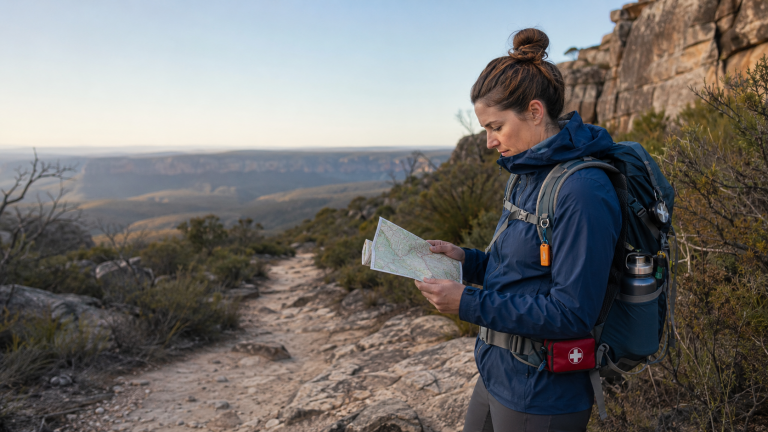
Tell a responsible person your route, vehicle location, turnaround time, and expected return. Download maps for offline use. The standard precautions in our hiking safety checklist still apply; blaze orange does not replace navigation, weather planning, water, first aid, or emergency communication.
What Color Should Hikers Wear?
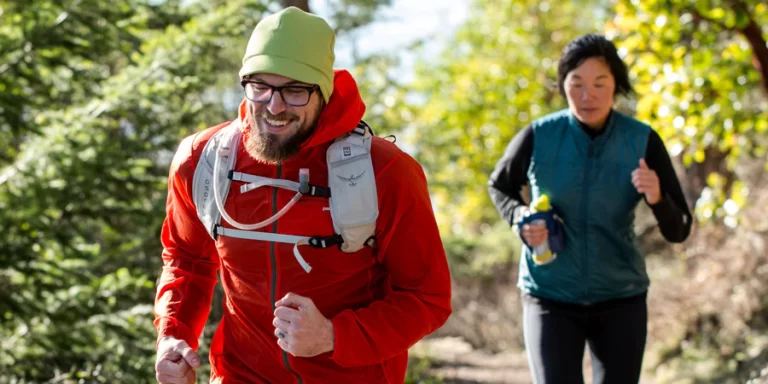
The most consistent official advice is fluorescent hunter orange, often called blaze orange. The U.S. Forest Service recommends wearing hunter orange as the outermost layer so other people can see it. Forest Service trail guidance also recommends an orange item visible from all directions, such as a hat, jacket, or vest, and suggests covering a backpack that blocks the view from behind.
A solid fluorescent orange outer garment is more useful than a small muted logo, rust-colored fleece, autumn-red shirt, or an orange layer hidden under a backpack. Colorado Parks and Wildlife notes that solid fluorescent orange or pink is legally defined for hunters in certain firearm seasons and that camouflage orange does not qualify for those hunter requirements. Non-hunters should not assume hunter clothing laws apply to them, but the visibility principle is useful: choose a large, solid, daylight-fluorescent area.
Wear visibility on both your torso and head when possible. Make sure a rain shell, pack, or insulating layer does not cover it. Avoid white outerwear in areas where Forest Service guidance warns that white can be mistaken for a deer’s tail. Every person in the group needs their own visible layer.
Trail Behavior When Hunters May Be Nearby
Stay on designated trails. This makes your route more predictable and reduces the chance of entering a designated hunting zone, blind area, or off-trail line of fire. Do not approach tree stands, blinds, decoys, harvested animals, or unattended hunting equipment.
Make your presence known calmly. If you see a hunter, a normal greeting is usually enough. Do not shout continuously, blow whistles without an emergency, interfere with a lawful hunt, or intentionally disturb wildlife. Give other users space and continue on the established route.
Keep situational awareness. Avoid wearing two noise-isolating earbuds. Listen for voices, dogs, vehicles, and posted instructions. Do not handle ammunition, firearms, or unfamiliar equipment found near a trail; note the location and contact the land manager if something appears abandoned or unsafe.
Respect closures immediately. A controlled hunt may temporarily close a trail or section of a park that is normally open. A map saved weeks earlier may not show a same-day closure. Posted signs and ranger instructions take priority over your planned route.
Hiking With a Dog During Hunting Season
Keep your dog leashed unless the land manager explicitly permits off-leash use—and consider using a leash even where it is optional. A roaming dog can leave the trail, approach hunters, chase wildlife, enter traps where trapping is legal, or become difficult to distinguish in thick cover. A leash also lets you move through a trailhead or encounter without depending on recall under stress.
Put a blaze-orange or high-contrast vest on the dog and check that the color is visible from both sides and behind. A small collar light can improve recognition in low light, but it does not replace daytime fluorescent coverage. Tags, reflective trim, and lights may disappear when a dog turns sideways or enters brush.
Review the area’s dog rules independently from its hunting rules. National parks and state parks can restrict dogs on trails even when nearby National Forest land allows them. Our dog hiking in bear country guide covers additional leash, food-storage, and wildlife considerations.
Three Amazon US Visibility Options
As an Amazon Associate, Old Ranger Days earns from qualifying purchases.
These products are included by use case using current manufacturer information. Old Ranger Days is not claiming personal testing, comparative performance, current pricing, sales volume, or universal suitability. Verify the exact color, model, and size before ordering.
Osprey Hi-Vis Raincover Small: pack visibility plus rain protection
Best use: day hikers whose backpack blocks the fluorescent garment on their back. Ideal buyer: someone carrying a 20–35 liter pack who also needs a rain cover. Osprey specifies a Mars Orange cover with reflective print, seamless coated fabric, and a wraparound attachment that cinches to the pack.
Key limitation: it covers the backpack, not your head or front. Reflective details depend on an external light source and should not be treated as a substitute for a fluorescent vest or hat. The small size will not fit every pack. Check the Osprey Hi-Vis Raincover on Amazon.
Ruffwear Lumenglow High-Vis Vest: daytime dog visibility
Best use: leashed dogs sharing wooded trails during hunting season. Ideal buyer: a dog owner who wants a blaze-orange, high-contrast shell with low-light reflectivity. Ruffwear lists a 600-denier polyester shell, weather- and abrasion-resistant construction, reflective panels, side-release buckles, a back leash portal, and light-attachment loops.
Key limitation: it is a visibility layer, not protective armor, insulation, or a guarantee that a dog will be seen through dense brush. Measure the widest part of the dog’s rib cage and confirm the selected Amazon variation is Blaze Orange. Check the Ruffwear Lumenglow vest on Amazon.
Nite Ize SpotLit Splash: supplemental dog visibility in low light
Best use: adding a visible point of light to a dog’s collar or harness near dawn, dusk, camp, or a dark trailhead. Ideal buyer: someone who wants a compact USB-C rechargeable clip light. Nite Ize lists glow and flash modes, four selectable colors plus a color-changing mode, up to 12 hours per charge, and an IPX7 rating for immersion up to 3.3 feet for 30 minutes.
Key limitation: a small light can rotate underneath a collar, become hidden by brush, or run out of charge. It does not replace a blaze-orange dog vest, leash, or headlamp. The USB-C cable is not included according to the manufacturer. Check the Nite Ize SpotLit Splash on Amazon.
When to Choose a Different Trail
Change the plan if the property page lists a controlled-hunt closure, you cannot confirm the boundary, visibility is poor, your group lacks high-visibility clothing, or your dog cannot remain reliably leashed. A no-hunting park may be a better option for a family hike, but verify the specific park because hunting rules vary among National Park Service units and state properties.
Also turn around if signs, flagging, vehicles, dogs, gunfire, or ranger instructions indicate activity that you did not anticipate. The goal is not to decide who has priority from the trail; it is to reduce uncertainty before an ordinary recreation day becomes a conflict.
Frequently Asked Questions
Is it legal to hike during hunting season?
Often yes, but access depends on the property and any temporary closure. Hunting season does not automatically close every trail, and an open hiking trail does not mean hunting is prohibited nearby. Check both the state season calendar and the land manager’s page.
Are hikers legally required to wear blaze orange?
Requirements vary by jurisdiction and may apply specifically to hunters or people accompanying hunters. Even where not required for hikers, the Forest Service and several state agencies recommend high-visibility orange. Check local law rather than treating a general recommendation as a nationwide mandate.
Is a bright red jacket as good as blaze orange?
Bright red may increase visibility, but fluorescent blaze orange is the most consistent agency recommendation. Choose a large solid area visible from multiple directions rather than a muted fall color or small accent.
Should hikers make noise around hunters?
Use a normal greeting to identify yourself when needed. Do not intentionally disrupt hunting, continuously shout, or use an emergency whistle unless there is an emergency. Stay on the trail and pass with space.
Can I bring my dog?
Only if the land manager permits dogs. Keep the dog leashed, add high-visibility coverage, and consider another trail if the dog is reactive, likely to chase wildlife, or difficult to control around other users.
Official Sources and Editorial Limits
Guidance and examples were checked on August 26, 2026 against the U.S. Forest Service trail-safety guidance, national Forest Service hunting guidance, New York DEC 2026 deer and bear seasons, Colorado Parks and Wildlife trail-sharing guidance, Pennsylvania DCNR hunting access information, and the National Park Service hunting portal.
Season dates, shooting hours, boundaries, closures, and clothing requirements can change. Verify the current state regulations and the exact property page on the day of your hike. Product details were checked against current Osprey, Ruffwear, and Nite Ize manufacturer documentation; availability and Amazon variations can change.
Old Ranger Days is research-based: we work from verified specifications and official sources, and never claim hands-on testing unless it happened. Some links may be affiliate links. Editorial policy · Affiliate disclosure