Old Ranger Days
Packs & Camp Gear
Camping Stove Types Explained: The Best Choice for Car Camping and Backpacking
In this guide
- Quick answer: which camping stove should you choose?
- Car-camping stove vs. backpacking stove
- The four main camping-stove types
- How much cooking power do you need?
- Fuel availability and U.S. travel rules
- Fire restrictions can change your stove choice
- Beginner stove-buying checklist
- Basic stove safety
- Our recommendation for most beginners
- Sources and product information
Choosing a camping stove is less about finding one universal “best” model and more about matching the fuel, burner design and packed size to the way you actually camp. A two-burner propane stove can transform a developed campsite into a practical outdoor kitchen, while a compact canister stove makes far more sense when every ounce must travel on your back.
This beginner-friendly guide explains the main stove types used in the United States, where each one works best and what limitations matter before you buy. Manufacturer specifications are verified where cited, but Old Ranger Days has not personally tested every product mentioned.
Quick answer: which camping stove should you choose?
- Developed campground or car camping: Choose a stable two-burner propane stove with independent flame controls.
- Weekend backpacking: A screw-on isobutane canister stove is usually the simplest balance of weight, speed and convenience.
- Boil-only meals and hot drinks: An integrated cooking system can be efficient and easy to pack, but it is less flexible for real cooking.
- Winter or extended remote travel: A liquid-fuel stove may perform more consistently and allows the fuel bottle to be refilled, although setup and maintenance are more involved.
- Areas under fire restrictions: Check the managing agency’s current rules. A stove that is normally legal may still be prohibited under local or temporary restrictions.
Car-camping stove vs. backpacking stove
| Feature | Car-camping stove | Backpacking stove |
|---|---|---|
| Typical format | One or two burners with a broad cooking surface | Compact burner or integrated pot system |
| Common fuel | Propane | Isobutane/propane canister or liquid fuel |
| Best for | Campground meals, families and groups | Meals carried into the backcountry |
| Main strength | Stability and cooking control | Low packed weight and volume |
| Main limitation | Bulky and heavy away from the vehicle | Small pot support and limited wind protection |
If you drive to the campsite, do not let backpacking-style minimalism make cooking harder than necessary. A broad two-burner stove lets you heat water while preparing food and supports normal camp cookware. If you hike several miles to camp, the same stove becomes unrealistic; packed weight, fuel availability and pot size become much more important.
The four main camping-stove types
1. Two-burner propane stoves
This is the familiar suitcase-style stove used at developed campgrounds, tailgates and roadside stops. It is the easiest choice for families and campers who want to cook with a skillet and saucepan at the same time. Look for independent burner controls, useful wind panels, a surface that is easy to wipe clean and enough space for the cookware you own.
The Coleman Cascade Classic is a representative example. Coleman lists two adjustable burners, 20,000 total BTUs, room for a 12-inch and a 10-inch pan, an 11-pound weight and up to one hour of high-output operation on one 16-ounce propane cylinder. Its size and weight suit vehicle-supported camping, not backpacking.
Best use: Campground meals for two to four people.
Ideal buyer: A beginner who wants familiar cookware and straightforward controls.
Key limitation: The stove and propane cylinder take substantial cargo space.
Check the Coleman Cascade Classic on Amazon US
2. Upright canister stoves
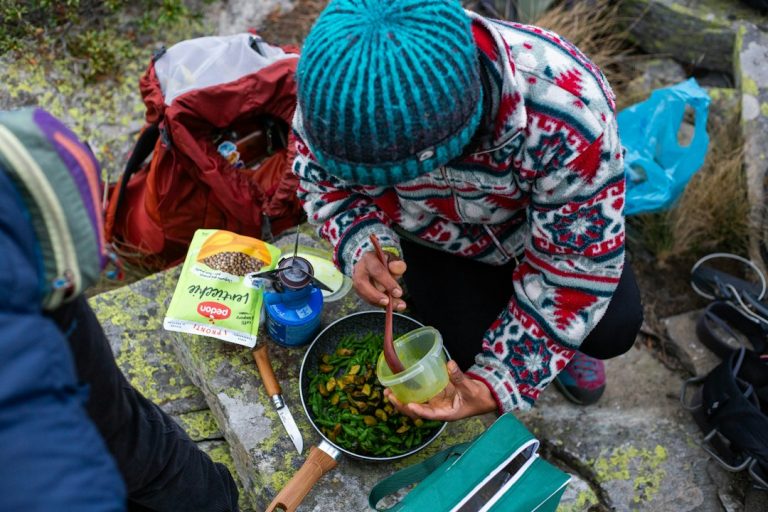
An upright canister stove screws directly onto a threaded isobutane/propane fuel canister. The format is compact, simple and popular for three-season backpacking. It works best with a modest pot on a level surface. The burner sits high above the ground, so stability and wind exposure deserve attention.
The MSR PocketRocket 2 represents this category. It is intended for lightweight backpacking and simple trail meals rather than group cooking. The small burner format packs easily, but users must supply compatible cookware and should avoid oversize pots that make the system top-heavy.
Best use: Solo or two-person three-season backpacking.
Ideal buyer: A hiker who values a small packed stove and already owns a suitable pot.
Key limitation: Less stable and more wind-sensitive than a low, remote-canister or tabletop stove.
Check the MSR PocketRocket 2 on Amazon US
3. Integrated canister systems
An integrated system combines the burner and a purpose-built heat-exchanger pot. It is especially convenient for boiling water for dehydrated meals, coffee or tea. The tradeoff is flexibility: narrow integrated pots are not always pleasant for simmering, frying or preparing meals that need a broad pan.
The Jetboil Flash illustrates the boil-focused design. Jetboil’s published specifications for the Flash system include a 1-liter cooking cup, a packed size of approximately 4.1 by 7.1 inches and a system weight around 13.1 ounces, excluding some accessories. Product generations and colors can change, so confirm the exact listing before purchasing.
Best use: Fast water boiling for solo hikers and couples.
Ideal buyer: Someone whose trail menu centers on just-add-water food and hot drinks.
Key limitation: Less versatile for conventional camp cooking.
Check the Jetboil Flash on Amazon US
4. Liquid-fuel stoves
Liquid-fuel stoves use a refillable bottle and are often selected for cold conditions, longer expeditions or destinations where threaded canisters are difficult to obtain. Some models can burn more than one fuel type. They require pumping, priming and periodic maintenance, making them a poor match for someone who wants the simplest possible weekend setup. For a detailed winter buying decision, read our canister vs liquid-fuel stove comparison for cold-weather camping.
The MSR WhisperLite International is a widely available multi-fuel example. Its value is not minimal setup time; it is the ability to support longer and more demanding trips when fuel logistics and cold-weather use matter.
Best use: Cold-weather travel and longer remote itineraries.
Ideal buyer: An experienced camper willing to learn priming and maintenance.
Key limitation: More components, noise and operating technique than a basic canister stove.
Check the MSR WhisperLite International on Amazon US
How much cooking power do you need?
BTU numbers are useful for comparing tabletop stoves within a similar design, but they do not tell the whole story. Wind protection, burner width, regulator design, cookware and ambient temperature all influence real cooking performance. A high-output burner with weak wind protection may waste fuel, while a lower-output system that transfers heat efficiently can boil water effectively.
For car camping, prioritize controllable heat over the largest advertised number. A low, steady simmer matters when cooking eggs, rice or sauce. For backpacking, consider the entire system—stove, pot, lid, wind management and fuel—not the burner weight alone.
Fuel availability and U.S. travel rules
- One-pound propane cylinders: Common near developed campgrounds, but disposal and recycling options vary.
- Threaded backpacking canisters: Available at many outdoor retailers, although selection near remote trailheads can be unreliable.
- White gas: Useful for refillable liquid-fuel systems and some expedition routes.
- Air travel: Fuel and fuel canisters are not normal carry-on items. Plan to obtain compatible fuel after arriving and consult current TSA and airline rules.
The National Park Service warns that disposable DOT-39 one-pound propane cylinders are intended for one-time use and should not be refilled. Consider a properly certified refillable cylinder for repeated car-camping use and follow local hazardous-waste or recycling instructions.
Fire restrictions can change your stove choice
Never assume that every “camp stove” is permitted simply because campfires are banned. Rules differ by agency, park, forest, elevation and restriction stage. During a June 2026 ban, North Cascades National Park allowed gas or propane cooking stoves with an immediate shutoff valve and a three-foot clearance from flammable material, while prohibiting devices that produced ash and propane fire pits. Other units may treat alcohol, solid-fuel and wood-burning stoves differently.
Before leaving home, check the current alerts page for the specific National Park, National Forest, BLM district, state park or county where you will camp. Recheck on the day of departure because restrictions can change quickly.
Beginner stove-buying checklist
- Decide whether the stove travels by vehicle or inside a backpack.
- Count the people and determine the largest pot or pan you will use.
- Check which fuel is realistically available near your destination.
- Choose a burner with enough stability for your cookware.
- Look for controllable heat, not only maximum output.
- Confirm current fire restrictions and shutoff-valve requirements.
- Test the complete system outdoors before the trip.
- Pack a backup ignition method even if the stove has a piezo igniter.
Basic stove safety
- Operate fuel-burning stoves outdoors in a well-ventilated location, never inside a tent, vehicle or other enclosed sleeping space.
- Set the stove on a stable, nonflammable surface away from dry grass, duff and overhanging materials.
- Inspect connections and seals according to the manufacturer’s instructions.
- Keep children, pets and loose clothing away from the cooking area.
- Let the stove cool before disconnecting fuel or packing it.
- Do not improvise a full windscreen around an upright canister; trapped heat can dangerously warm the fuel canister.
Our recommendation for most beginners
For developed campgrounds, start with a two-burner propane stove. It is stable, familiar and flexible enough for real meals. For backpacking, begin with a reputable threaded-canister stove and a modest pot, then practice the complete setup close to home. Choose an integrated system only if your menu is mainly built around boiling water, and move to liquid fuel when winter performance or expedition logistics justify the added complexity.
Continue planning with our Outdoor Gear Guide, Fall Camping Checklist and Wildfire Smoke and Hiking guide.
As an Amazon Associate, Old Ranger Days earns from qualifying purchases.
If you are choosing a stove for a drive-up campsite, compare it with the rest of your kitchen, shelter and storage system in our car-camping equipment guide.
Sources and product information
- National Park Service: Propane Canister Safety for Campers
- National Park Service: 2026 North Cascades fire restrictions
- Coleman: Cascade Classic specifications
- Jetboil: Flash system specifications
Old Ranger Days is research-based: we work from verified specifications and official sources, and never claim hands-on testing unless it happened. Some links may be affiliate links. Editorial policy · Affiliate disclosure